

Courses for Each Stage of the Family Archive Blueprint™
Clear, step-by-step instruction for preserving, organizing, and stewarding your family archive.
Stage 1 of the six-stage Family Archive Blueprint™.
Join the list for release dates and early access.
How the Courses Fit into the Blueprint
The Family Archive Blueprint™ is based on the full process archivists use to bring order, meaning, and long-term care to collections.
The courses are how you learn that process.
Each course covers one stage of the Blueprint and walks you through exactly what to do at that point. You complete one stage and then move to the next.
Some courses may be available now. Others will open over time.
This page shows the entire path so you can see where you are, what comes next, and how each stage fits into the whole.
These Courses Are for You If…
- You have inherited photos, papers, or keepsakes and want to handle them properly.
- You want clear steps, not guesswork.
- You want archivist-informed guidance adapted for home use.
- You want progress without making irreversible mistakes.
- You want an archive your family can understand and use.
The Six Courses of the Family Archive Blueprint™
COURSE 1
STAGE 1: Stabilize Before You Categorize
Stabilize what you have and take the first protective steps before you sort anything.
Course Overview:
When you first open inherited boxes or albums, it can be hard to know what matters and what might be at risk. This course shows you how to open and assess materials safely, notice potential problems early, and gather essential context before anything gets sorted or moved.
By the end of this stage, you know exactly what you are working with and what needs attention first, without pressure to make decisions you are not ready for.
You will learn how to:
- Open boxes, albums, and loose materials safely
- Notice signs of damage, instability, or risk early
- Handle fragile items without causing harm
- Capture basic information about where items came from
- Avoid early missteps that can create confusion or damage later
Purpose of this stage:
You become familiar with what you have and begin to establish context.
Best for:
Anyone who has just inherited family materials and wants to open and assess them carefully before making decisions.
COURSE 2
STAGE 2: Keep Together What Belongs Together
Create simple, meaningful groupings and deal with fragile items.
Course Overview:
Once everything has been opened and assessed, the next challenge is figuring out how the pieces relate to one another. This course shows you how to create simple, meaningful groupings so you can see the collection more clearly without over-sorting or getting stuck.
You will also learn how to separate and set aside fragile items so they are protected while you continue making progress.
You will learn how to:
- Spot natural relationships among photos, papers, and keepsakes
- Create simple groupings without committing to final organization
- Separate materials by type while keeping context intact
- Set aside fragile or high-risk items safely
- Keep moving forward without getting buried in decisions
Purpose of this stage:
You can see the collection clearly without overthinking it.
Best for:
Anyone who has stabilized their materials and needs a clear way to see what they have without over-sorting.
COURSE 3
STAGE 3: Simple Structure that Sticks
Create the structure that makes everything easier.
After you can see what you have, this course helps you turn loose groupings into a clear, workable system. You will learn how to choose an organizing structure that fits your materials and your real life, not an idealized archive.
By the end of this stage, you have an order you can maintain, so your archive stops feeling like a collection of piles and starts functioning as a system.
You will learn how to:
- Choose an organizing structure that fits your materials and space
- Create folders and labels that make sense to you and your family
- Turn temporary groupings into a stable system
- Keep the system simple enough to maintain over time
- Track what you have without complicated tools
Purpose of this stage:
Your family archive functions as a system, not a set of piles.
Best for:
Anyone who is ready to move from loose groupings to an organizing system they can actually maintain.

COURSE 4
STAGE 4: Buy Once. Store Right.
Use the right archival supplies without overspending or guesswork.
With an organizing system in place, this course focuses on long-term protection. You will learn how to choose storage supplies that actually make a difference, how to house different formats correctly, and how to store your archive safely at home.
The goal is confidence. You know your materials are protected without overbuying, overhandling, or guessing.
You will learn how to:
- Decide which archival supplies actually matter
- House different formats correctly
- Store materials safely in your home
- Reduce common environmental risks
- Skip unnecessary products and handling
Purpose of this stage:
Your materials are protected without guesswork or excess.
Best for:
Anyone who wants to store their family archive safely for the long term.
COURSE 5
STAGE 5: Save the Story, Not Just the Stuff
Add context, meaning, and provenance to your family archive.
Course Overview:
Once materials are organized and protected, this course helps you record the information that gives them meaning. You will learn how to document names, relationships, origins, and stories, even when details are incomplete or uncertain. Most people never do this step.
This stage turns an organized collection into something your family can understand and use, not just store.
You will learn how to:
- Record names, relationships, and ownership history
- Capture context even when details are incomplete
- Write notes your family can understand and use
- Turn scattered information into clear documentation
- Add meaning without needing perfect answers
Purpose of this stage:
Your archive carries understanding, not just order.
Best for:
Anyone who wants their family archive to carry meaning and context, not just order.
COURSE 6
STAGE 6: Plan It. Protect It. Pass It On.
Prepare your family archive for long-term care and future generations.
This final course looks ahead. It helps you plan for the ongoing care of your archive, decide how it will be passed down, and reduce common risks that can undo earlier work.
By the end of this stage, you have a clear plan for stewardship so the time and care you invested continues to matter in the future.
You will learn how to:
- Plan for long-term care of your family archive
- Decide who will take responsibility in the future
- Reduce risks that can undo earlier work
- Create a simple stewardship plan
- Ensure your work remains usable and meaningful over time
Purpose of this stage:
Your archive has a future beyond you.
Best for:
Anyone who wants to plan for the future care of their family archive and ensure their work continues to matter.
The Complete Family Archive Blueprint™
Together, these six courses teach the complete Family Archive Blueprint™, from your first box through long-term stewardship.
Once all stages are available, the full Blueprint will also be offered as a single bundled option for families who prefer the entire path in one place.
Available Now: Photo Digitizing Courses
These courses are not part of the Family Archive Blueprint™, but they complement it. They focus specifically on digitizing family photos using archivist-informed methods and can be taken at any point. If digitizing is something you want to address now, these courses stand on their own.
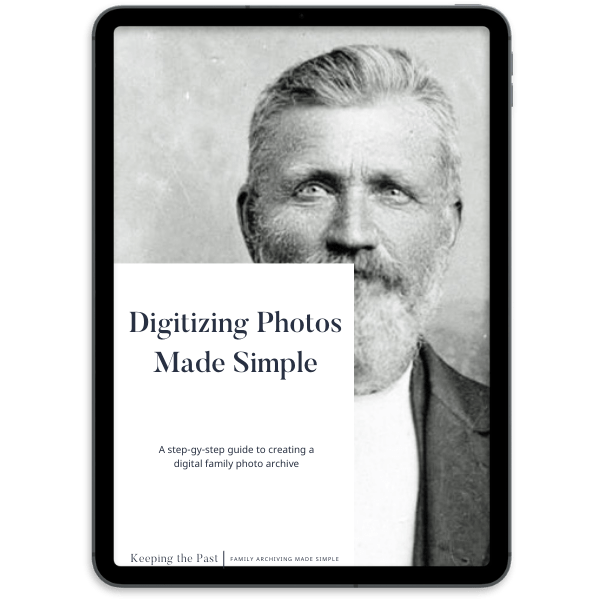
Digitizing Photos Made Simple
A step-by-step guide to creating a digital family photo archive.
Learn how to create a digital family photo archive that stands the test of time and is passed down for generations—using the methods and techniques archivists use.
Includes:
- Course Video Modules
- Simple Simple Workflows
- Course PDFs
- Bonus Tech Tutorials
$147
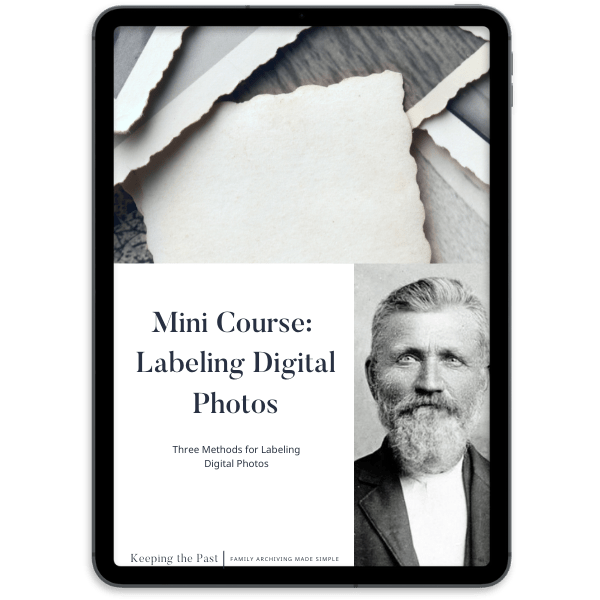
Mini Course: Digital Photo Labeling
Module 03 of Digitizing Photos Made Simple—available as a single module
Digital Photo Labeling gives you what you need so that you don’t end up with a bunch of unidentified (mystery) scanned images.
Includes:
- Video Lessons
- Lesson PDFs
- Bonus Tech Tutorials
$25
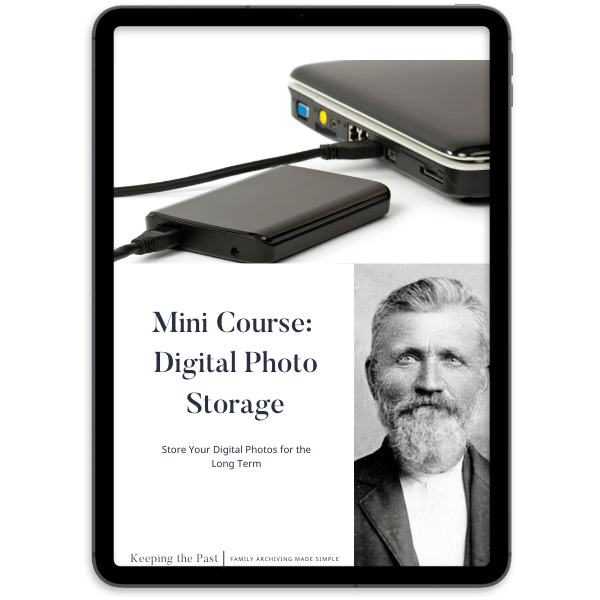
Mini Course: Digital Photo Storage
Module 04 of Digitizing Photos Made Simple—available as a single module
You spent the time scanning your old photos because you want the digital versions to be around to view and to share for the long term.
Learn what you need to know to keep your digital photos from becoming inaccessible.
Includes:
- Video Lessons
- Lesson PDFs
- Bonus Tech Tutorials
$25
Start Where You Are
If you want a clearer picture before beginning the courses, the First Pass Guide helps you orient yourself.
It walks you through the early protective considerations and helps you understand what you are working with before moving into the Blueprint courses.
This guide is meant to prepare you, not replace the courses.
before starting the courses

Your Archivist Guide
I’m Pamela. I use my archival experience to help families understand and care for the photos, papers, and keepsakes they have inherited.
The Family Archive Blueprint™ is grounded in established archival practices, adapted for real homes and real families. The guidance focuses on clear steps, practical decisions, and steady progress, without requiring professional training or perfect conditions.
Questions, Answered
Do I have to complete the whole Blueprint?
No. The Blueprint is designed as a complete path, but each stage stands on its own.
Every stage you complete improves the condition, clarity, and safety of your family archive. You are not committing to finishing everything. You are choosing to make things better than they were before.
What if I need to stop partway through?
That is expected. Family archiving happens in seasons, not straight lines.
The courses are designed so you can pause at the end of any stage without undoing your work. Even if you stop, the improvements you made remain in place and continue to matter.
How much time do the courses take?
The courses are designed to be taken in short, manageable sessions, with time in between to apply what you learn to your own materials. There are no deadlines and no required pace.
You decide how quickly or slowly you move. Even small amounts of time lead to meaningful improvement.
Do I have to follow the courses in order?
Yes. The stages are designed to be taken in sequence so each step supports the next and prevents unnecessary rework.
Following the order keeps the process clear and reduces the chance of mistakes. You can still move slowly or pause as needed, but the structure remains the same.
Will I lose access if I stop for a while?
Each course includes at least 18 months of access. Enough time to step away and return without losing ground.
How is the First Pass Guide different from the courses?
The First Pass Guide is a short, free orientation designed to help you take the first protective steps and understand what you are working with.
The courses go deeper. Each course teaches one full stage of the Blueprint with structured lessons, examples, and decision guidance so you can complete that stage with confidence.
Do I need professional archival training to take these courses?
No. The courses are based on professional archival best practices, but they are taught for home use.
They are designed for people without formal training, specialized equipment, or ideal conditions.
Do I need to buy archival supplies right away?
No. Early stages focus on understanding and stabilizing what you already have.
When supplies are introduced, the courses explain which choices matter, which ones can wait, and which are unnecessary. Purchasing decisions are intentional, not rushed.
What if my materials are incomplete, messy, or confusing?
That is normal. Most family archives begin that way.
Are these courses only for large collections?
No. The Blueprint works for collections of all sizes.
The same stages apply whether you are working with a single box or many years of materials.
Will these courses help with both photos and documents?
Yes. The Blueprint is designed for mixed family materials, including photos, papers, and keepsakes.
Guidance is provided for different formats within a single, coherent system.
Can more than one family member use the courses?
Yes. Sharing access with family members who are working together on the same archive is welcome.
The courses are intended for use within one household or family project and are not meant to be shared beyond that. This helps keep the courses accessible and sustainable for everyone.
What happens when all stages are available?
Once all six stages are open, the complete Family Archive Blueprint will also be offered as a single bundled option for families who prefer the full path in one place.
Individual courses will remain available for those who want to move one stage at a time.
Follow the Blueprint, One Stage at a Time
Whether you are just beginning or planning your next step, this page shows the full path forward.
Every stage you complete makes your family archive safer, clearer, and more meaningful.
Less guessing. More “oh, that makes sense.”
Practical family archiving ideas and resources, delivered monthly.