
What is a Family Archive?
If you inherited family photographs, papers, letters, or keepsakes and aren’t sure where to begin, this page will help you understand what you have, what matters, and what comes first.
A family archive is not something most people plan
to create.
They inherit one.
It often arrives quietly.
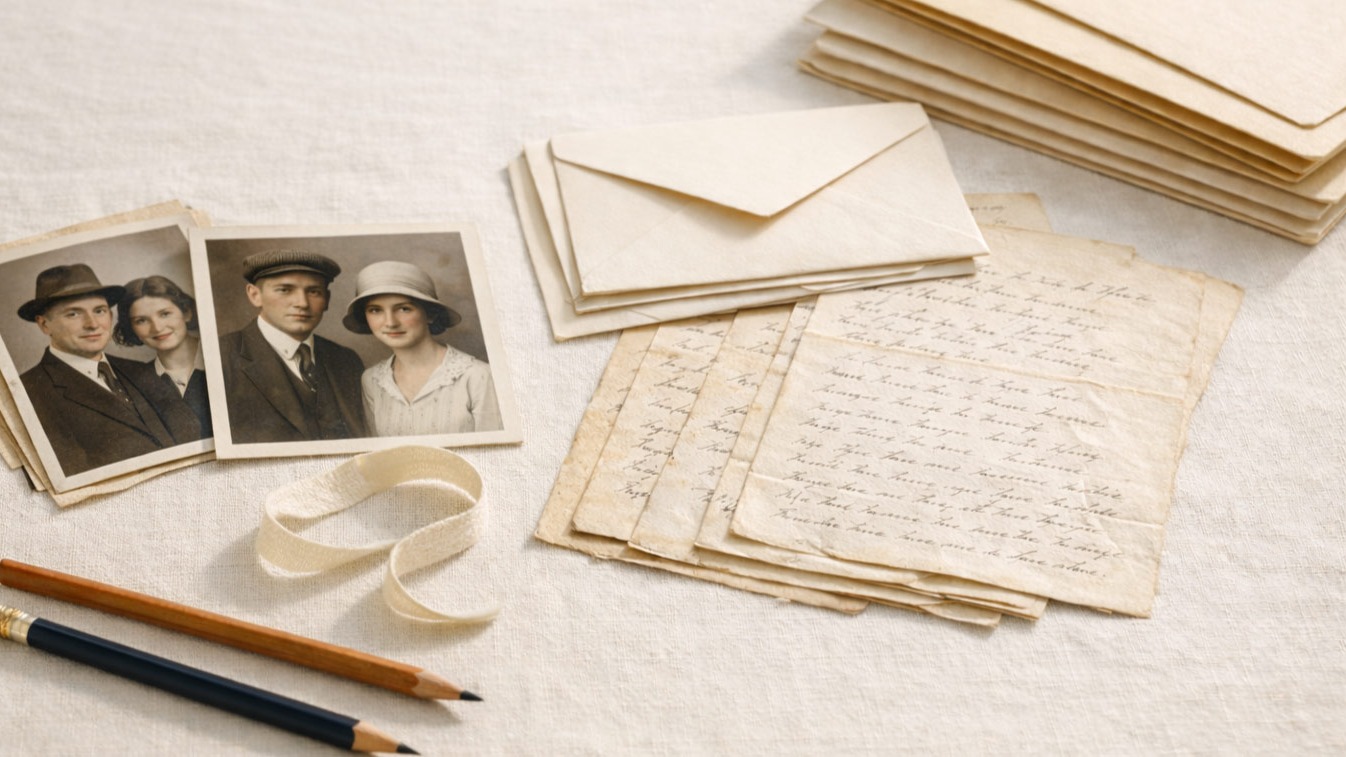
A box of photographs.
A drawer of papers.
Albums tucked under a bed.
Items kept because they felt important, even if no one explained exactly why.
You usually know right away that these things matter.
What’s less clear is what they actually are, the role they play in your family’s story, and how to approach them without losing something along the way.
A Family Archive, Defined
A family archive is the collection of family photographs, papers, letters, and keepsakes preserved not just as objects, but as evidence of lived lives and relationships.
Sometimes the meaning is obvious.
Sometimes it isn’t.
What matters is that these items didn’t survive by accident.
Family archives are shaped not only by formal documents or milestone moments, but also by ordinary items that quietly record daily life, relationships, and events.
A family archive grows over time.
It is shaped through care, context, and intentional decisions.
Understanding what a family archive is helps you see these materials as more than clutter or an unfinished organizing project.
It gives you a steadier footing before you make any decisions about what comes next.
If You’ve Inherited Family Photos or Papers and Don’t Know What to Do First
This is usually the point where people hesitate.
You may be staring at boxes of photographs, letters, or documents and thinking, I know these matter, but I don’t know what I’m supposed to do with them. You’re not even thinking about how to organize everything or how to store it perfectly. Just how to start without making a mess of something you can’t replace.
Most people pause here because the materials feel important, but the path forward feels unclear.
What happens if I sort too quickly—and accidentally separate items that were kept together for a reason or let go of something before understanding why it was saved in the first place?
This page is meant to slow that moment down.
Before any organizing or preservation decisions are made, there is a first step that protects both the materials themselves and the relationships between them.
Once that first decision is clear, everything that follows becomes easier to approach.
Stabilizing Comes Before Organizing
Most people assume the first step is organizing.
It feels sensible. Productive. Reassuring.
But organizing too early can quietly undo the very thing you’re trying to protect.
When items are sorted before they’re understood, context is often lost. Photographs get separated from letters. Notes slip away from the papers they were tucked inside. Small details that once explained *why* something mattered disappear without anyone realizing it.
Stabilizing is different.
Stabilizing means giving your materials a safe pause before you make decisions about them. It’s the moment where nothing is sorted, labeled, or rearranged. Instead, the focus is on keeping items intact, supported, and handled carefully so you have time to see what you’re working with.
This is how archivists prevent irreversible mistakes.
Stabilizing protects fragile materials, but just as importantly, it protects relationships between items. It keeps stories from being broken apart before they’ve been noticed.
Organizing comes later.
Stabilizing makes that possible.
Your Reason Shapes Your Family Archive
There is no single reason people decide to care for family materials.
Some want to pass down stories.
Some want to protect photographs or documents.
Some feel a sense of responsibility.
Some are simply tired of wondering what to do with the boxes they’ve inherited.
All of these reasons are valid.
What matters is that your reason shapes the choices you make.
It influences what you keep, how you handle it, and how much time and energy you invest.
A family archive doesn’t have to be exhaustive to be meaningful. It only needs to reflect what matters to your family and to the people who will inherit it after you.
Another family’s archive may look very different from yours, and that’s not a problem.
There is no single right outcome. There is only an approach that respects both the materials and the people connected to them.
Understanding your reason doesn’t lock you into a plan.
It gives you permission to proceed thoughtfully, without rushing toward someone else’s version of “done.”
Practical archiving guidance, delivered to your inbox
Each issue includes updates about the latest blog posts and courses, one practical archiving tip, and occasional free resources available only to subscribers—checklists, guides, and tools you won’t find anywhere else on the site.
Short, useful, and worth your time.
Where to Begin
You don’t need to do everything at once.
But you do need a way forward that makes sense.
Caring for family materials works best when it follows a clear sequence. Not because everything has to be perfect, but because certain decisions are much easier when they happen in the right order.
The Family Archive Blueprint is built around that idea.
Before organizing, labeling, or making long-term plans, there is a first step that helps you pause and protect what you already have. It clarifies what to do now, and what to leave alone until later.
The first step is not organizing.
It’s learning what not to do yet.
That foundation makes the rest of the Blueprint possible.
Start Here
The First Pass Guide
Know what to do before you sort anything.
This short guide walks you through how to:
- Take a clear first step that keeps everything safe until you’re ready for more
- Know what to notice now, and what to leave alone for the moment
This is the same approach archivists use to prevent irreversible mistakes.
Choose Your Path (Optional Reading)
If you want to go deeper, these articles expand on specific questions. They are not required to begin.
Understand what a family archive actually is and why what you already have counts.
Read → What a Family Archive Actually Is
Learn why stabilizing comes before sorting and how a slower beginning protects both materials and meaning.
Read → Your First Pass: Why Stabilizing Comes Before Sorting
Reflect on family archiving and let your reason guide what comes next.
Read → Why YOU Family Archive: Your Reason Guides the Way
Final Orientation
A family archive is not about doing more.
It is about doing the right things in the right order so what matters survives long enough to be understood.
This page is here whenever you need to return to that grounding.
Know what to do next—and what can wait
Each issue includes updates about the latest blog posts and courses, one practical archiving tip, and occasional free resources available only to subscribers—checklists, guides, and tools you won’t find anywhere else on the site.