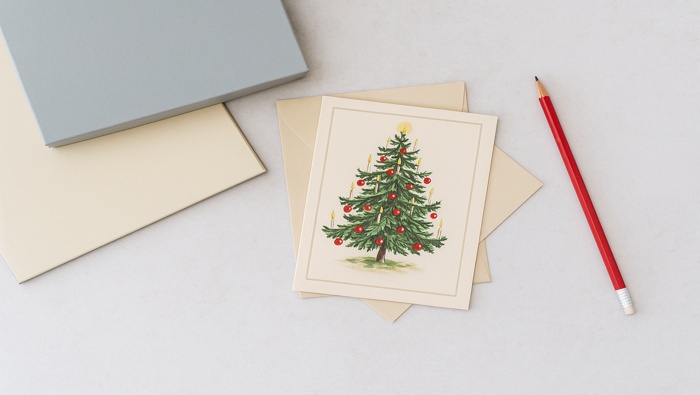
Every December, mantels and doorways fill with bright envelopes and cheerful greetings.
Some are glossy photo cards of growing families, others are handwritten notes with a bit of news tucked inside. Most people glance, smile, and eventually tuck them away in a drawer—or more often, into the recycling bin.
But when I open a box of old Christmas cards, I don’t just see holiday cheer. I see a timeline of lives, evidence of relationships, and snapshots of changing times. In short, I see the family archive unfolding in paper and ink.
That instinct to see more than paper is rooted in understanding what a family archive actually is and how meaning accumulates over time, often in the most ordinary places.
And that raises an important question: when your grandchildren open the cards you’ve saved, what will they see?
Seeing with “An Archivist’s Eyes”
It’s easy to think of holiday cards as temporary. They arrive in December, bring a burst of connection, and then quietly disappear by January. Yet to an archivist, they are far more than seasonal sentiment. Christmas cards are small time capsules.
The handwriting tells us who took the time to sign with care. An address shows where someone lived at a particular moment. The artwork reflects design trends that, decades later, feel instantly recognizable. Even a casual line—“Jimmy lost his first tooth” or “Dad started a new job”—anchors a family’s timeline in ways no official record ever will.
The truth is, once these cards are gone, those details are gone too. Learning to see with what I call “archivist’s eyes” doesn’t mean you need to keep every scrap of mail. But it does mean pausing before you toss them out, asking: Does this belong in my family archive?
This pause is intentional. Learning to see how everyday items fit within a family archive before deciding what to keep is what protects both meaning and context.
At Keeping the Past, I believe everyday artifacts are the threads that hold family history together. You don’t need special training to recognize value. You only need a willingness to look more closely. A Christmas card may seem ordinary, but when viewed as part of your family archive, it becomes a tangible piece of the story.
What an Archivist Notices in a
Christmas Card
Here’s what archivists naturally look for when they open a box of holiday greetings:
✔ Handwriting — Every signature is unique. Over time, handwriting can show personality, health changes, or the steady hand of a much younger self.
✔ Addresses — The return address on the envelope, or the recipient’s address if you’ve kept it, maps out where people lived and moved. These are breadcrumbs of family migration.
✔ Postmarks and Stamps — The tiny circle of ink on an envelope does more than cancel a stamp. It gives you an exact date and place, grounding the card in time.
✔ Family Mentions — Notes about new babies, graduations, illnesses, or jobs often appear in short holiday updates. These small remarks create anchor points in your family archive.
✔ Artwork and Design — From mid-century block prints to 1980s glitter to today’s glossy photo collages, design styles track cultural changes over decades.
✔ Paper and Printing — The type of paper, quality of ink, or printing method can suggest an era and sometimes even family finances.
✔ Senders and Recipients — Who appeared year after year on the mailing list? Who dropped off? Holiday correspondence maps family and social networks over time.
✔ Annotations — Occasionally a card hides more: a recipe, a news clipping, or a longer handwritten note slipped inside. These extras offer unexpected glimpses into daily life.
Christmas cards remind us that history doesn’t live only in official documents. It also hides in the ordinary rhythms of life.
Preserving Christmas Cards the
Archivist’s Way
Noticing the stories is one step. Keeping them safe is the next. Professional archives balance protection with practicality, and you can borrow the same methods at home without needing expensive supplies.
✔ Remove Cards from Envelopes
Envelopes matter—the handwriting, postmarks, and addresses are part of the story. But don’t store the cards inside their envelopes. Remove the card, then save both pieces together in the same folder.
✔ Keep Context Together
If you’ve kept the envelope, it belongs with its card. A simple sheet of folded paper will keep them together inside the folder.
✔ Store Cards Open
Paper weakens along folds. Storing cards open reduces stress on the crease and makes inside notes easier to see. It also reduces bulk.
✔ File Folder Storage
Group cards by family, decade, or sender. Place them in acid-free file folders, the same kind used in archives. From there, you can store folders flat in a box or upright in a document case—choose what works best for your archive-friendly storage space.
This straightforward approach is both practical and sustainable. It avoids the expense of placing each card in a clear sleeve, but still protects this important part of your family archive for the long term.
Why It Matters
Without context, a stack of cards may look like clutter. But when you start to see them with archivist’s eyes, the meaning shifts. That messy pile becomes a record of family connections, cultural trends, and personal milestones.
Christmas cards remind us that history doesn’t live only in official documents. It also hides in the ordinary rhythms of life: annual greetings, quick updates, shared traditions. When you notice these details, you sharpen your ability to see value in other parts of your family archive.
Most of all, preserving cards is about keeping a sense of presence. The loop of handwriting, the postmark from a small town, the affectionate note—these are human traces, fragile but enduring, if we care for them.
Looking Twice This Season
This December, as you open the envelopes arriving in your mailbox, pause before you set them aside. Hold the card, study the handwriting, glance at the address, notice the design. Ask yourself if this belongs in your family archive.
You don’t need to keep every card. But by saving a thoughtful selection and storing them with care, you create a future moment when someone else will hold that card and recognize more than a holiday greeting. They’ll recognize a piece of their family story.
And that, in the end, is what keeping the past is all about.
Sometimes the best gift you can give yourself is a fresh start with your family treasures.
If you’ve been meaning to begin, the First Pass Guide will walk you through the very first step. It’s free, simple, and ready when you are.