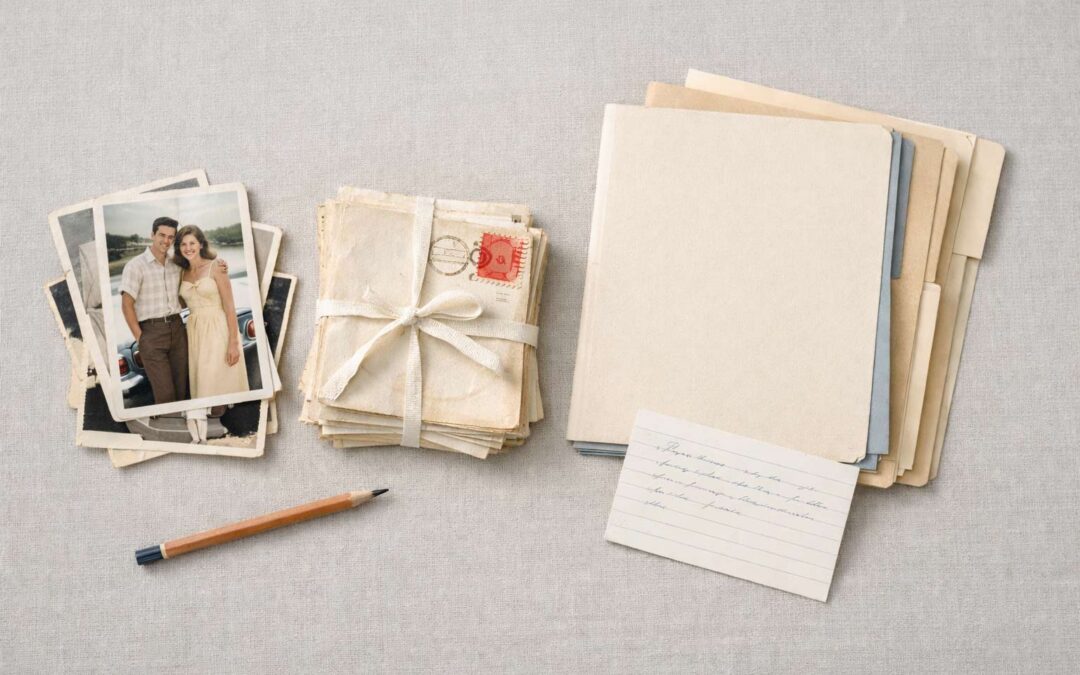
Most people don’t set out to create a family archive.
They inherit one.
It arrives without ceremony. A box. A drawer. Albums tucked under a bed. A stack of papers no one quite knows what to do with.
You know right away that it matters. What’s harder to name is what it’s supposed to become.
That uncertainty is more common than you might expect. Many families live with it for years, holding onto things carefully but without a clear sense of what those materials represent or how they fit together.
When people inherit family materials in this state, the challenge is rarely urgency. It’s orientation. Understanding what a family archive is helps clarify how to think about these materials before any decisions are made.
Why It’s Hard to Start Without a Definition
When people say they don’t know where to start, it’s usually not because they’re stuck.
More often, they don’t know what they’re aiming toward.
It’s hard to move forward when the destination is fuzzy. Should you rehouse everything? Should you be organizing? Should you be doing something else entirely?
Once you understand what a family archive actually is, the questions change. You start asking better ones. What needs protection first? What belongs together? What can wait.
The work doesn’t disappear, but it gains direction. This is where things start to click.
A Clear, Practical Definition of a Family Archive
A family archive is not a museum collection.
And it isn’t a set of perfectly organized boxes.
It is a cared-for body of family materials, held with intention, context, and respect. Photographs, papers, letters, textiles, and keepsakes that are protected from damage, kept in relationship to one another, and understood as part of a larger family story.
It grows over time. What matters most is stewardship, not productivity.
And it doesn’t begin at the end. It begins with care.
What a Family Archive Can Look Like in Real Life
A family archive is not measured by size.
It can be small.
It might be:
- One album of photographs from a single generation
- A bundle of letters tied with ribbon
- Three folders tucked into a kitchen drawer, holding birth certificates, a few photographs, and handwritten notes
- A handful of documents saved from an estate clean-out
- A box you inherited and haven’t opened yet
In many families, a small archive lives quietly alongside everyday life. If those materials belong together and matter to your family, that is a family archive.
A family archive can also be transitional.
It might look like:
- Two boxes brought home after someone else’s downsizing move
- Materials gathered quickly, without time to sort
- A mix of photos, papers, and keepsakes placed together for safekeeping
- Items you know matter, even if you’re not sure how they fit together yet
This middle stage is common. It’s where many family archives live for a long time.
A family archive can also be larger.
It might include:
- Several boxes spanning multiple generations
- Photographs, papers, and memorabilia mixed together
- Materials from more than one branch of the family
- Items that have already been passed down more than once
Even then, it is still one archive, growing in stages and shaped gradually as understanding increases.
What makes it an archive isn’t how much you have or how long it has been in your care.
It’s that you are keeping these materials because they carry meaning, history, and connection.
If You’re Wondering What Comes First
If this is helping you see what you’re already holding, the next question is usually what
to do first.
What a Family Archive Is (and Is Not)
A family archive is:
✔ Something that can be added to over time
✔ Defined by care, not completion
✔ Built through decisions made in a thoughtful order
✔ Valid whether it fits on a shelf or fills a closet
✔ Already forming the moment you decide it matters
A family archive is not:
✘ A requirement to sort or organize everything immediately
✘ Invalid because items are mixed or incomplete
✘ Dependent on special supplies or ideal conditions
✘ A finished product you arrive at in one season
If you’ve been holding onto these materials because you know they matter, you’re not waiting to start.
You’ve already started.
Why It Matters
When people understand what they’re creating, their decisions change.
They hesitate less.
They second-guess themselves less.
They stop measuring progress by speed or volume.
Knowing that you are building a family archive can help protect you from making permanent choices too early, especially when time feels short or emotions are close to the surface. It gives you a reason to pause before sorting, discarding, or separating things that belong together.
Instead of asking, “What should I do with all of this?” the question shifts to, “How can I take good care of what I have right now?”
Seeing your materials as a family archive, rather than a pile that needs fixing, changes what comes first and what can wait.
Once the definition is clear, your direction becomes clear, too.
A Final Thought
Your family archive doesn’t need to look like anyone else’s. It only needs to be cared for with intention. That choice is what turns inherited materials into a family archive.
This is how family archives actually get built.
When You’re Ready for the First Step
I’ve put together a short First Pass Guide that shows the initial protective steps you can take before sorting or making decisions.