It’s Not What You Think
I was listening to a podcast—Daniel Lubetzky, the founder of KIND, talking with Simon Sinek on the A Bit of Optimism. He said that studies have shown that people who understand where they come from make better long-term decisions.
Wait! What? That’s a big claim. So I looked it up.
The research is real. And it doesn’t just support the claim—it reframes the value of your family archive.
It’s Not Only About Keeping Things Safe
Most people who hold onto boxes of old family photos, letters, and documents already know those things are irreplaceable. But the reason to preserve them goes well beyond preventing loss.
Your family archive—the collection of items that, together, tell your family’s story—is quietly doing something for the people connected to it. Something measurable. Something researchers have been tracking for over two decades.
One important distinction before we get into it: this isn’t about the boxes themselves. A box of mystery contents no one can identify isn’t telling a family story. It’s just stuff. (I wrote about how that happens here.) The benefit kicks in when the stories behind the items are known, told, and passed along.
That’s what makes a family archive different from a box of old things.
And that’s where the research gets very interesting.
The Hard Stories Are the Ones That Matter Most
At Emory University, Dr. Marshall Duke and Dr. Robyn Fivush spent years tracking what happens when children know their family’s history. Kids who knew more about where they came from had higher self-esteem, stronger friendships, and less anxiety. That alone is worth paying attention to.
But not all family stories carried the same weight. The ones that made the biggest difference followed a specific arc—things were going well, something went wrong, the family came through it. Duke called it the “oscillating narrative.” The story of struggle and recovery.
Now think about what’s sitting in your boxes. Those war letters. The displacement records. The Depression-era photographs. They’re preserving exactly the kind of story the research says matters most—not simply relics of hard times, but evidence of resilience. And they’re among the materials families lose first.
If You’re Wondering What Comes First
If this is helping you see what you’re already holding, the next question is usually what to do first.
Your Archive Is Shaping Identity—Even If No One’s Opened It in Years
A team at Cardiff University studied what families keep and why, and their conclusion is worth thinking about: families build their sense of identity—consciously or not—through the things they choose to hold onto.
The researchers called the family archive “an important and undervalued site of meaning and identity construction.” The decision to keep something is already an act of identity. Someone looked at those items and said, this matters.
But here’s the catch. The full value unlocks when someone can connect the contents to the people they belonged to and the story they tell. The keeping is the foundation. The knowing is what makes it count.
The Chain of Stories Is More Fragile Than You Realize
This finding from BYU confirmed what I always felt: young adults with the healthiest sense of identity—connected to their family and confident in their own direction—also had the highest levels of family history knowledge. Not just closeness to their family. Actual knowledge of the family’s story.
Now pair that with something the Emory researchers discovered. In most families, grandmothers are the principal storytellers. They’re the ones carrying the narrative thread across generations.
When a generation gets skipped—because of distance, estrangement, early loss, or just life moving too fast—the stories go with it. Most people don’t realize how quickly that happens. One missed generation, and the thread breaks.
A family archive is the hedge against that silence. It holds what the research says matters, even when the person who would have told the story is no longer there to tell it.
The Photos Are Doing More Than Decorating
Children who grow up seeing family photos displayed develop a stronger sense of who they are and where they come from. Professor Geoff Beattie at the University of Manchester describes it as how children learn to place themselves within a family—who these people are, and where they fit among them.
Not decoration. Orientation.
Photos happen to be among the most common items in a family archive—and among the most vulnerable. Worth knowing the next time you’re deciding what to protect first.
What This Looks Like in Real Life
So what does it actually look like to connect your family to the story your archive holds?
It doesn’t take a finished project. It can start this week.
Pull out one photo and ask a question. One image. “Do you know who this is?” You’d be surprised how much story follows—and how much gets passed along just in the asking.
Tell a hard story on purpose. The research is clear: the stories that build the most resilience aren’t the cheerful ones. A letter from a difficult year. A document from a turning point. A photograph from a time the family would rather forget. These are worth saying out loud—because they carry the arc of recovery that the next generation needs to hear.
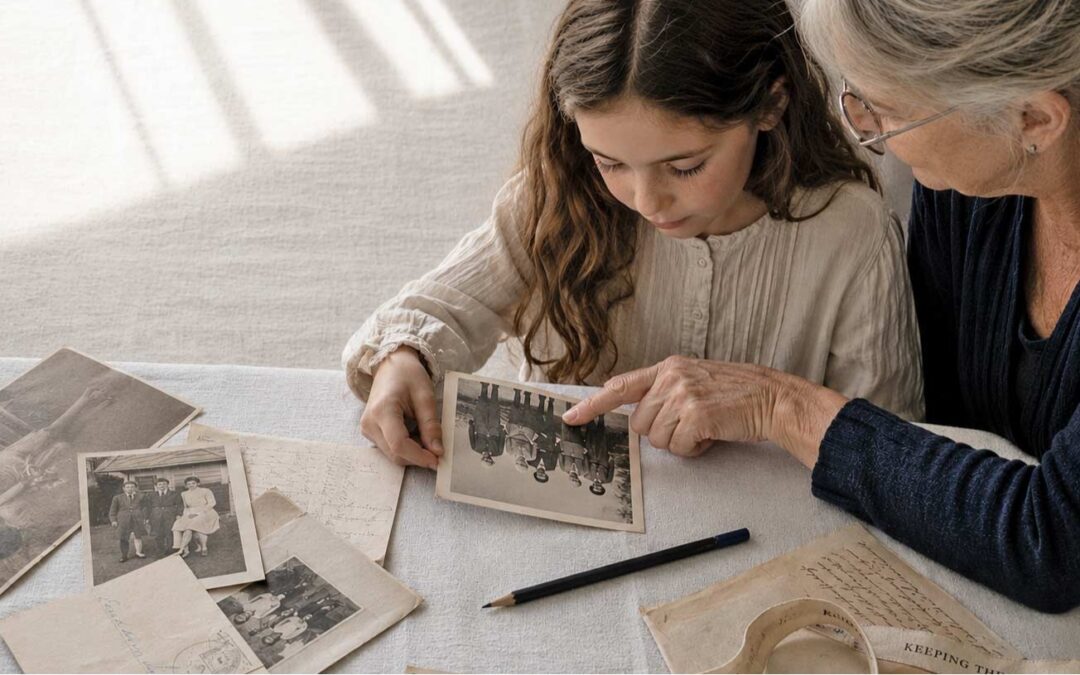
Let someone hold something old. There’s a difference between hearing about your great-grandmother and holding a letter she actually wrote. Physical objects create a kind of connection that words alone can’t. This is especially powerful for teenagers, who are right in the middle of the identity work the research describes.
Start answering the questions no one thinks to ask. The Emory researchers built a 20-question scale called “Do You Know?” designed to measure how much children know about their family’s history. Questions like:
Do you know where your grandparents grew up? Do you know how your parents met? Do you know the story behind your name? Do you know about a family member who overcame something difficult?
Most families can’t answer all twenty. Your archive probably holds more of those answers than anyone realizes. And every single one matters.
What the Research Tells Us
Your family archive is a collection of physical evidence—photographs, letters, documents, objects—that together carry your family’s story. Not the polished version. The real one. The one with hard chapters and unanswered questions and handwriting you’d recognize anywhere.
The research is consistent: knowing that story builds resilience, shapes identity, grounds the next generation, and gains value every time someone new gets to hear it.
The materials are already in your care. The stories are already inside them.
Practical archiving guidance, delivered to your inbox
Each issue includes updates about the latest blog posts and courses, one practical archiving tip, and occasional free resources available only to subscribers—checklists, guides, and tools you won’t find anywhere else on the site.
Short, useful, and worth your time.