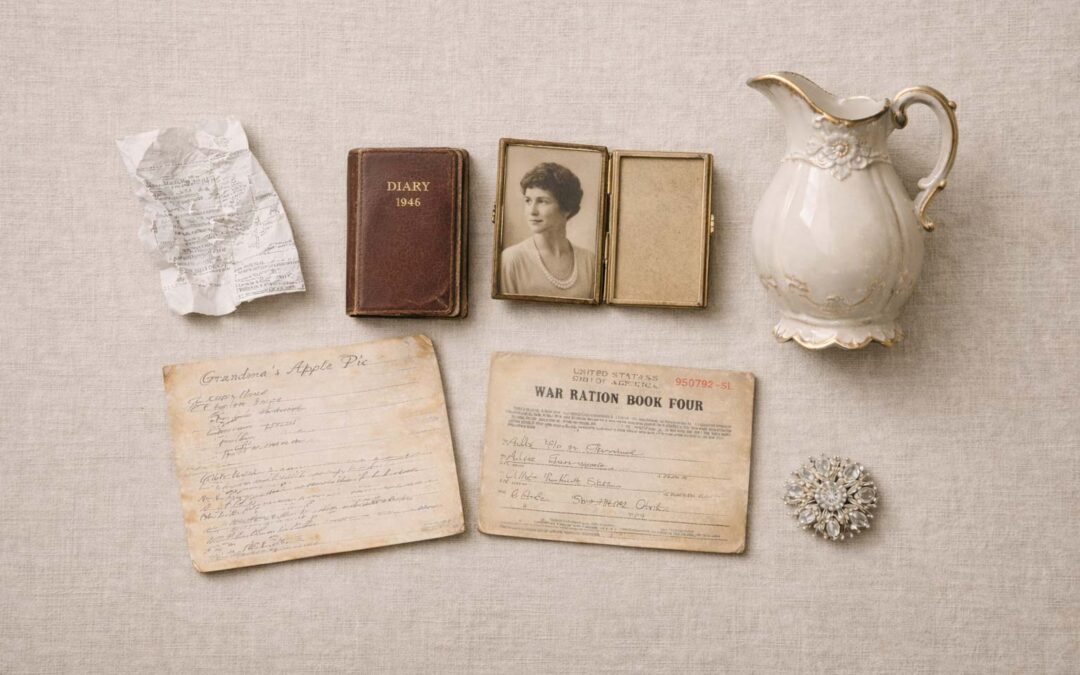
You know that feeling when you’re staring at boxes of your parents’ stuff—or your grandparents’ stuff—and you’re genuinely paralyzed?
Like, there’s your dad’s college transcript sitting next to a random key that opens who-knows-what and a stack of greeting cards from people you’ve never heard of, and you literally cannot figure out which of these things matters? Understanding how to approach your family archive starts with asking the right questions.
I’ve been there. The thing is, you’re stuck because you’re asking yourself the wrong question. You’re probably thinking, “Is this valuable?” or “Might I need this someday?” when what you actually need to ask is, “Does this help tell my family’s story?”
Mindset Shift: From Monetary Value to Story Value
Forget organizing your family archive like it’s an antiques roadshow or an estate sale. That whole “valuable versus worthless” framework? It’s going to lead you astray every single time.
Try this instead: “Does this illuminate our family’s story?”
The crumpled receipt from the purchase of your grandmother’s engagement ring matters infinitely more than some pristine but anonymous antique pitcher you inherited from a distant relative you never met. The spelling test where your dad misspelled “Wednesday” but his teacher wrote “Great effort, Danny!” in the margin? That’s gold. That generic china set with no known history? Just dishes.
Your family archive should answer “Who were we?” not “What could we sell?”
And listen, this shift is liberating. You don’t have to keep things out of guilt about their potential monetary worth. You get to keep “worthless” items—scraps of paper, ticket stubs, worn-out objects—that carry profound family significance.
Make this mental shift and the whole sorting process gets easier.
Learn more about building a family archive that tells your story.
What Makes an Item Archive-Worthy: The Criteria
So what actually earns something a place in your family archive?
An item belongs when it:
Tells a specific story about a specific person in your family.
The rationing stamps that got your great-grandfather through WWII, not just any old WWII memorabilia that happened to come into the family. The difference is connection. Can’t connect it to YOUR people and THEIR experience? It’s historical, but not a family archive item.
Provides context that would otherwise be lost.
Letters, diaries, annotated recipes, margin notes in books—these capture voice and personality in ways nothing else can. How someone thought, what made them laugh, what they worried about, how they made decisions. These details disappear if you don’t preserve them.
Marks a significant moment or transition.
Immigration papers, marriage certificates, military discharge documents, diplomas, job offer letters, that telegram announcing a birth. The hinges of a life—the moments when everything changed.
Shows relationships and connections.
Photos where someone actually wrote names and dates on the back (bless them). Correspondence between family members. Letters from friends. Documents that show the web of people surrounding your family.
Represents a family tradition, skill, or value that was passed down.
Your grandfather’s woodworking tools matter if he taught everyone in the family to build things. Your great-aunt’s handwritten recipe cards matter if cooking was her love language and Sunday dinners were sacred. Random tools or random recipes without that connection? Just objects.
Contains irreplaceable information.
Birth records, family trees someone painstakingly compiled, genealogical documentation, information that simply cannot be reconstructed. The factual skeleton that everything else hangs on.
Would help future generations understand their origins.
What would your great-great-grandchildren want to know? They’re going to wonder where they came from, what mattered to the people who came before them, what their ancestors were like as actual human beings.
If You’re Wondering What Comes First
If this is helping you see what you’re already holding, the next question is usually what
to do first.
Why It Matters: The Purpose of a Family Archive
Memory is fragile. You can tell your kids about their grandmother all day long, but holding the letter she wrote to your grandfather during their courtship? That’s different. That’s real in a way that transcends description.
Context dies with each generation. Every time someone passes away, we lose the person who could explain what things meant, why they mattered, and how they fit into the larger story.
Without you actively curating, your descendants inherit boxes of complete mystery objects. The meaning was right there, and then it evaporated.
Your choices right now shape what gets remembered. Every archive is an act of interpretation—you’re deciding which threads of the family story survive.
You’re the bridge. And you’re not keeping these things for yourself.
This is about passing along identity and continuity to people who don’t exist yet but who will want to know where they came from.
Selective preservation honors what you keep. An overstuffed family archive makes it harder to see what truly matters.
Thoughtful curation? Each item carries weight. Each object means something.
This is about passing down what these things mean, and that’s more valuable than money or objects.
The Test: Can You Tell Its Story?
Pick up the item. Now imagine explaining its significance to someone who doesn’t know your family. Can you do it?
If yes—if you can say, “This is my mother’s nursing school pin from 1967, she was so proud of that accomplishment” or “This is the letter my grandfather wrote the day he arrived in America, you can see how nervous he was about the new language”—it probably belongs.
If no—if it’s beautiful but you genuinely don’t know who owned it, when, why it mattered, or what it meant to anyone—it probably doesn’t belong in a family archive. (Might still deserve a place in your home for other reasons, but that’s different.)
When in doubt, add context. Write it down. Attach a note. Create documentation that travels with the item.
What This Means When It’s Time to Sort
You have permission to let things go. Not because they’re unimportant, but because they don’t serve the specific purpose of preserving your family’s story.
You also have permission to keep the scrap of paper, the humble everyday object, the “worthless” item that tells an essential story. That note your mom stuck in your lunchbox when you were ten? Keep it.
As for what to actually do with all the things you decide not to keep? Well, that’s a story for another day. 😉
When You’re Ready for the First Step
I’ve put together a short First Pass Guide that shows the initial protective steps you can take before sorting or making decisions.