My very first box didn’t come from my side of the family.
It came from my husband’s grandmother. She was over 90 when she handed it to me, and she did it with the confidence of someone passing along a crown jewel. She knew I loved family stories. When she trusted me with her own collection, I felt honored. Truly honored.
And she had everything. Both she and her late husband were only children, so nothing had ever been divided. Every letter, every album, every odd little scrap had landed in their care, and now it was in mine.
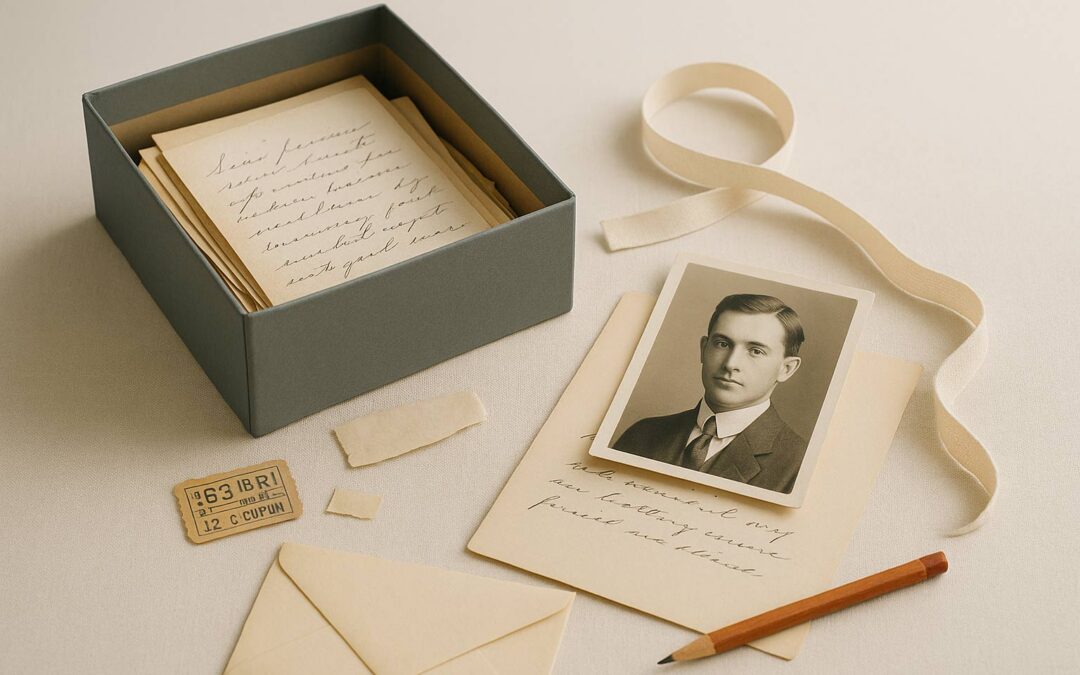
The “container,” however, was an old cardboard box with a torn lid. Not exactly archival. I took one look and thought, “I really should do better for this.” And then I put it in my closet.
It sat there for years.
Some of the pieces inside had already survived a century, so they also survived my closet. But when I finally opened the box, I did exactly what I am gently encouraging you not to do. I started moving things around far too quickly. This was before I studied archiving in graduate school, long before I understood how much those first moments shape everything that comes after.
When I look back, what I was missing most wasn’t better supplies or better intentions, but a clear sense of what a family archive actually is and how to understand the materials before acting.
I wish I had slowed down. I wish I had let the materials introduce themselves instead of trying to decide their fate.
That is what this post is really about—beginning in a way your future self will thank you for.
Slow Down and Notice
Most people open a box and think, “All right, let’s organize this.” I did the same. It feels productive. It feels tidy. It feels like the sensible thing to do.
But starting a family archive is less about sorting and more about noticing.
Even if things look random, there is a very good chance that someone kept each item on purpose, for a reason that made perfect sense to them.
When you slow down, you start learning something not only about the item, but also about the keeper. Why this letter. Why this photograph. Why this one receipt tucked behind a portrait.
A family archive isn’t a sprint. It’s more like meeting a relative you’ve heard about for years but never actually met. You ease in. You listen. You let things unfold at their own pace.
The early days are full of tiny clues you won’t see if you rush past them. A handwriting style. A date that appears in more than one place. An envelope that suddenly explains a photograph.
A slower beginning isn’t about being precious. It’s about giving yourself room to understand what you’re looking at before making decisions that are easy to undo in theory but not in practice.
Understanding precedes action.
Observation precedes sorting.
Curiosity precedes clarity.
This is why archivists slow the beginning down. Taking time to understand what you’re working with and what comes first in a family archive changes how every later decision feels.
And once you settle into that rhythm, the whole experience becomes far more enjoyable.
Before you sort anything, the First Pass Guide shows you exactly how to begin without rushing or making decisions you may later wish you’d delayed.
Why Your Beginning Shapes Everything
At Keeping the Past, I know that the early questions we ask shape everything that comes after. A thoughtful beginning doesn’t require expertise or special supplies. It simply asks you to notice what is in front of you. That’s where meaning hides. In the handwritten notes, the tucked-away scraps, the small choices someone once made.
When you approach your materials with attention and patience, you give yourself the chance to see their story as a whole and not just pieces to be sorted. That mindset is the foundation of everything we teach, because clarity grows from understanding, not speed.
What I Wish I Had Known Early On
✔ Your first impression of the materials is a clue, not a command.
✔ Nothing needs to be decided immediately.
✔ Small scraps often carry surprising meaning later.
✔ You will change your mind as you learn more, and that’s normal.
✔ The goal isn’t to get through the box. The goal is to understand what’s inside it.
✔ You don’t need fancy supplies on day one. You just need a little time and attention.
✔ A family archive grows clearer the more you sit with it.
A Slower Start Protects the Story
A thoughtful beginning protects you from early mistakes you can’t always undo. It also protects fragile items that don’t announce their fragility until you’re holding them.
When you take time to understand the collection as a whole, later steps go more smoothly. Patterns emerge. Stories take shape. You stop worrying about doing everything at once and start noticing what the materials are trying to tell you.
You might have a box in the guest room, or stacks in the closet, or letters tucked in drawers. It’s normal not to know where to begin. What matters is that you’re willing to begin thoughtfully.
Your family archive doesn’t expect perfection. It simply asks for attention. Every time you sit with these materials, you learn something new.
If you’d like a simple and clear next step,
the First Pass Guide shows you how to begin a family archive slowly and thoughtfully. It focuses on what to notice first, what not to decide yet, and how to protect both the materials and the story they carry. You don’t need to have everything figured out. You just need a place to start.