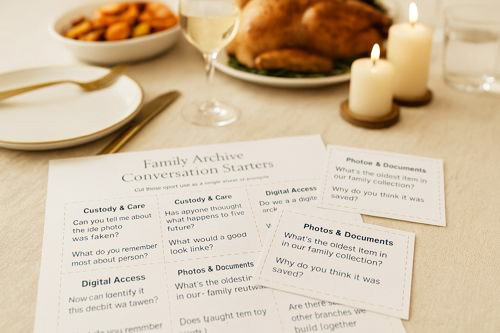
Does everyone know who holds the family archive?
Thanksgiving is one of the few times when several generations gather around the same table. Between the laughter, second helpings, and familiar traditions, you also have a rare opportunity: the chance to talk about your family archive.
The box of photographs in Aunt Susan’s closet. The bundle of letters your grandfather saved. The digital files somebody scanned years ago but no one can quite remember where. These are the threads of your family story, and they deserve more than being tucked away and forgotten.
These conversations work best when everyone has a shared sense of what a family archive actually is and why it matters beyond the box or folder it lives in.
A Gentle Truth
It’s easy for everyone to assume “someone” is taking care of the family archive. However, unless you’ve talked about it, that “someone” may not even realize they’re the keeper—or worse, they may have no plan for what comes next.
Preserving family history doesn’t mean you need formal meetings or complicated systems. Instead, it begins with ordinary conversations during ordinary moments—like Thanksgiving dinner. For example, a simple question, a shared memory, or an old photo at the table can be the spark that keeps your history safe and alive.
At Keeping the Past, I believe preserving a family archive goes beyond simply keeping items in boxes or digital folders.
A family archive only gains meaning when it connects to the people, places, and stories that bring it to life. That’s why conversations matter. They transform collections from things we keep into a legacy we understand, value, and share.
Questions to Spark Conversation
Even a simple conversation goes more smoothly when everyone shares a basic understanding of what counts as a family archive and why these materials matter to the family as a whole.
Here are a few simple but meaningful prompts to guide your Thanksgiving table (or living room) discussion:
✔ Custody of the Family Archive – Who currently has the photos, letters, and documents, and where are they stored? Knowing this prevents the archive from being forgotten in an attic or lost during a move. It also ensures the family knows who to turn to when questions come up.
✔ Plans for the Future – Is there a plan for what happens if that person can’t continue caring for the family archive? Without a clear plan, family collections can easily become scattered or even discarded. Talking through this now can save heartache later.
✔ Digital Archives – Does your family have a digital family archive? Who manages it, and who has access to it? (Make sure to share logins or subscription details safely.) A digital collection is only as strong as its accessibility, so it’s important to make sure it doesn’t vanish with one person’s email account.
✔ Photo & Document ID Sessions – Gather together with old photos (be sure to keep the food and drinks far away). Work together to identify faces, places, and handwriting before those memories fade. Even a single name added to the back of a photo can mean the difference between a forgotten picture and a story that lives on.
✔ Storytelling Moments – Encourage older relatives to tell stories about the people and places in the photos. Ask someone to record or write them down. These moments often reveal details you cannot find in any official record.
✔ Additional Questions – What might be missing from the family archive? Are there stories or items held by other relatives that could be brought together? For instance, sometimes a cousin across the country holds pieces that complete your puzzle—and you wouldn’t know until you ask.
The stories and photos you share today become the history your family keeps tomorrow.
Why It Matters
When these conversations don’t happen, family archives often slip through the cracks. Boxes get misplaced, digital files become inaccessible, and stories disappear with the people who know them.
But when you do talk—when you ask questions and listen carefully—something important happens. Everyone becomes part of the archive. Older relatives add details only they know. Younger ones begin to see themselves as caretakers of something valuable. And as a family, you gain peace of mind because you know the memories and materials won’t vanish simply because no one asked.
So, a family archive isn’t only about preservation—it’s also about participation. It’s a living story that exists because people choose to share it.
A Thanksgiving Invitation
This year, let the mashed potatoes and pumpkin pie share the table with your family story. Start small. Ask who has the photos. Pass around a picture and see who remembers the faces. Or share a story that hasn’t been told in years.
Every conversation you begin is one more step toward protecting what matters most.
Ready to spark meaningful conversations at your holiday table? I’ve created a free resource to help you:
Family Archive Conversation Starter Cards.
Use them to spark stories, laughter, and a plan to keep your family archive safe for the future.