The Place Felt Right. That’s the Problem.
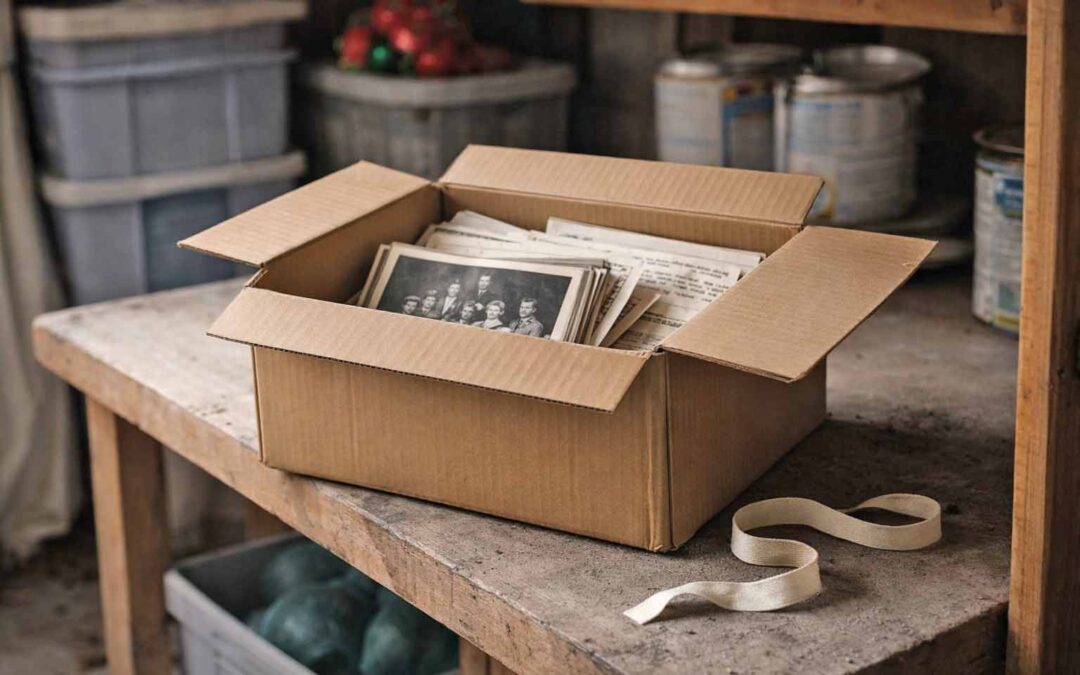
Somewhere in this house, there’s a box. Maybe a stack of them. Tucked into the attic, pushed to the back of the basement, slid onto a garage shelf between the holiday decorations and the paint cans.
It seemed like the right place at the time.
Out of the way. Safe from everyday chaos. Tucked in with other things that needed to be kept.
Here’s the problem: the places we instinctively reach for when storing inherited family materials—attics, basements, garages—are about the worst possible environments for them.
Not because the intention was wrong.
Just because common sense and archival sense aren’t the same thing. And the gap between them is where collections quietly disappear.
What “Climate Controlled” Actually Means
Most living spaces are climate-controlled. The attic, basement, and garage usually aren’t.
When you’re carrying a box up the stairs, you’re thinking about where it will fit. Not about what the temperature up there reaches in August. And it gets surprisingly extreme up there.
Attics, garages, and many basements sit entirely outside your home’s HVAC system. In summer, attic temperatures climb well past anything your living spaces ever see. Winter reverses that.
And humidity rides along with all of it—rising and falling with every shift in the weather.
Here’s the part that surprises most people: the swings are more damaging than the extremes. A steady cold is actually easier on archival materials than the constant cycle of hot, cold, humid, dry.
Every shift makes materials expand and contract. Paper turns brittle. Photographs stick together or pull apart at the emulsion layer.
It’s slow. It’s invisible. And it adds up every single year.
Attics, basements, and garages all swing. Every year.
If This Has Started You Thinking
The 3 Basic Steps guide covers Location — and two other things worth doing now.
The Threats You Can’t See
Temperature and humidity get most of the attention. But they’re not the only forces working against you.
Light. Direct sunlight is the obvious culprit. But even indirect light causes fading over time.
A storage space with windows—or one that gets light every time the door opens—is quietly doing damage. Color loss, surface wear. Whether anyone notices or not.
Moisture. The dramatic version—a flood, a burst pipe—is the one people worry about. But moisture damage doesn’t need a disaster to get started.
Condensation and ambient humidity do quiet, cumulative work. An interior closet in the climate-controlled part of the house, away from exterior walls, is a far better choice.
Pests. Paper, leather, textiles, adhesives—insects and rodents love all of it.
A storage space that shares real estate with seasonal gear, food, or gardening supplies is sending an open invitation. Your collection doesn’t need that kind of company.
None of these threats announce themselves. That’s precisely what makes them worth understanding now.
It’s Been Fine So Far—Hasn’t It?
This is the thought that keeps many people from acting.
The box has been up there for years. Nothing terrible has happened. The photographs still look like photographs. The letters are still legible. The albums are still intact.
But past survival isn’t evidence of current safety. It’s evidence that the damage hasn’t been discovered yet.
Deterioration is cumulative. It stays invisible until it crosses a threshold. The collection looks the same right up until it doesn’t. By then, the process has been underway for a long time.
The years a collection spends in the wrong environment aren’t neutral time. Every summer’s heat. Every winter’s cold. Every swing in between. It all counts.
The question isn’t whether change has occurred. It’s how much—and whether what remains can still be stabilized.
Most people have no idea anything is happening. That’s not a failure of attention—it’s just how deterioration works. Gradually. Invisibly. Without announcing itself.
The Part That Can’t Be Undone
Most household problems are fixable. A leaky pipe gets repaired. A broken appliance gets replaced. Things go wrong, you deal with them, and life moves on.
Environmental damage to archival materials doesn’t work that way.
Once a photograph has faded, it has faded. Once paper has gone brittle, it stays brittle. Once an image separates from its emulsion layer, it’s gone. There’s no restoration that brings a degraded item back to what it was. Only varying degrees of what’s been lost.
That’s not a scare tactic. It’s just what these materials are.
Here’s the thing about temporary storage: it has a way of becoming long-term. The box that was only going to stay in the attic until there was time to deal with it properly? Time passes before most of us notice it already has.
Homes aren’t built to archival standards—and they don’t need to be. No residential space checks every box. The goal isn’t a perfect environment. It’s the best one available, chosen on purpose. That’s exactly what this is.
The good news: the right location doesn’t require a renovation or a big investment. It requires a decision. And once you understand what’s actually at stake—and what the factors are—that decision gets a lot clearer.
One thing worth saying: if this collection is still here, someone made sure it survived. That’s not nothing. Most family materials don’t make it this far. The fact that there’s something here to protect is already the most important part of this story.
Practical archiving guidance, delivered to your inbox
Each issue includes updates about the latest blog posts and courses, one practical archiving tip, and occasional free resources available only to subscribers—checklists, guides, and tools you won’t find anywhere else on the site.
Short, useful, and worth your time.