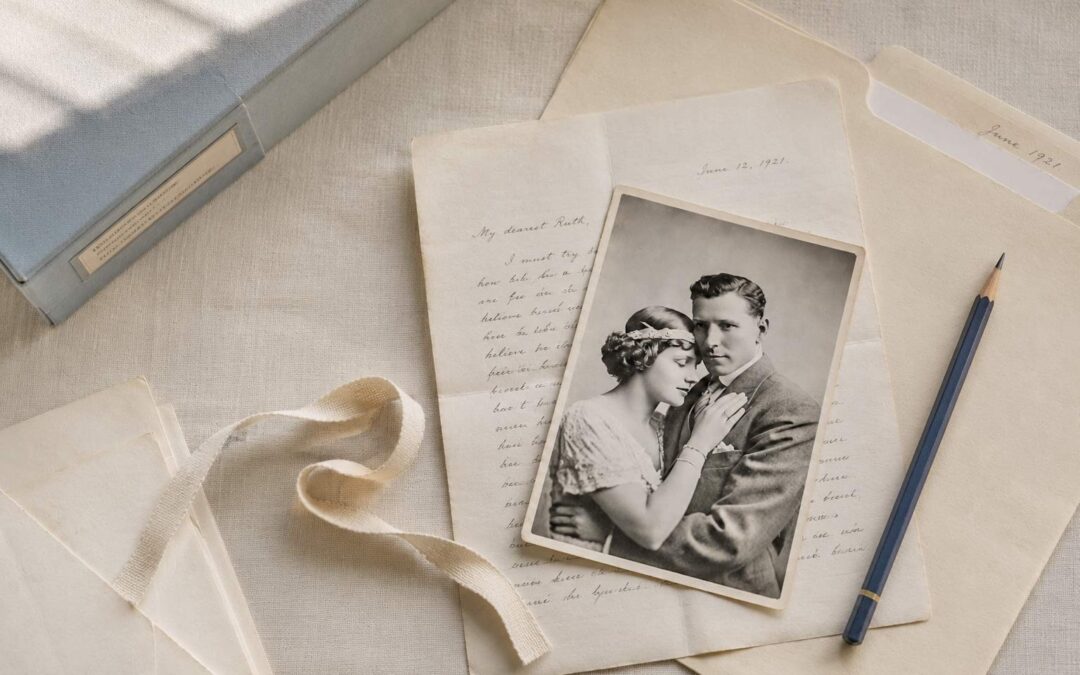
Your Wedding Was One of the Most Documented Days of Your Life. Here’s What to Actually Keep.
In one single day, a wedding generates more documentation than most people collect in years.
Invitations. Programs. A signed marriage license. Handwritten vows. Hundreds of photographs—maybe thousands. Notes passed between people who loved you before you even walked down that aisle.
Whether that day is coming up, just happened, or happened a few years ago (okay, maybe more than a few)—the same question applies:
What do you actually do with all of it?
What lands in that envelope, that bag, that box—whatever it becomes—is genuinely remarkable.
It’s a complete, documented record of one of the biggest days of your life. Who was there. What you promised each other. What your mom wrote to you that morning.
That’s not just stuff. That’s a primary source collection.
And whether it’s still in the photographer’s delivery box or it’s been in your closet since 2011, it deserves a plan.
A Mindset Shift
Most of us think of wedding keepsakes as mementos. Sentimental objects. Nice to have. Vaguely guilt-inducing when they’ve been in a box too long.
An archivist looks at a wedding collection and sees something completely different.
The dress? A textile artifact. The invitation suite? A social and design record of exactly who you were and how you celebrated in this particular moment in time.
The vows you wrote by hand at the kitchen table the night before? A primary document. Your actual handwriting. Your actual words. The actual paper you held when you made the biggest promise of your life.
This is the shift: stop thinking of these things as keepsakes and start thinking of them as evidence.
Evidence of a day, a relationship, a family, a moment in history that will never exist again exactly as it did.
What an Archivist Would Save
Not everything from your wedding carries equal weight. Some items are irreplaceable. Some are nice to have. Some can go.
Here’s how to think about the categories:
- Photographs—including the ones you don’t love. The outtakes and candids often capture more truth than the posed portraits. Fifty years from now, someone in your family will want to see the faces in the background. Keep more of them.
- The proof book or album, if you have one. A bound, chronological record of the day in a single object. Future generations will reach for this first.
- The invitation suite. Invitation, save-the-date, program, menu card—the documentary record of how you announced and structured the day. That typography, that color palette—that’s 2020 in an envelope.
- Your handwritten vows. Keep the original paper. A printout is not the same thing. Handwriting is evidence of a person in a way that typed text simply isn’t.
- Notes and letters from the day. A note from your spouse slipped under the door that morning. A card from your mom. These are the most moving items in a wedding collection—and the most commonly lost because nobody thinks to treat them as archival material.
- The marriage license and marriage certificate. The license belongs with your important papers—in a safe, a safe-deposit box, or wherever you keep the documents that matter. The certificate goes in the archive. If you ordered a certified copy of the license, that can live there too.
- A newspaper announcement or printed copy. These date and contextualize the event in a way photographs alone don’t—and they disappear fast if nobody thinks to save one.
- A few pieces of the day’s texture. The florist’s order. The music playlist. The ceremony timeline. Not everything—but one or two items that tell the story of how the day was built.
A Word About the Dress
The dress gets its own moment here because it’s the item people agonize over most.
It deserves the attention.
As a textile artifact, a wedding dress has genuine archival value. It’s a record of craft, fashion, and personal choice that future generations will find remarkable in ways you might not expect.
Your great-granddaughter is going to want to see that dress.
But it’s also the most preservation-complex item in your entire wedding collection. How it’s cleaned, how it’s folded, how it’s stored, and what it’s stored in all matter—a lot.
A plastic bag is not the answer. Neither is the box from the bridal shop.
If You’re Wondering What Comes First
If this is helping you see what you’re already holding, the next question is usually what to do first.
Why It Matters
A wedding collection is a rare thing in a family archive—a single day, completely documented.
Not fragments. Not a handful of loose photographs with no names on the back.
A full record of one specific day: who was there, what was said, what everyone wore, what the table looked like, what your mother wrote to you before you walked down the aisle.
Most family history doesn’t come to us that way. It comes in pieces—a few letters, some photographs, a document here and there. We spend years trying to reconstruct stories from scraps.
Your wedding collection is already whole. It’s already there.
Think about what it would mean to find your grandmother’s handwritten vows someday. To read exactly what she promised. To see the note her mother slipped into her hand that morning. To hold the actual paper.
That’s not sentiment. That’s connection across time—the kind that only happens when someone decides the materials were worth keeping and worth protecting.
The people who come after you will want to know who you were. Not just that you got married, but how you did it. What you chose. Who showed up. What it looked like.
That’s all sitting in a bag right now. And it’s closer to safe than you might think.
You Don’t Have to Keep Everything
A focused collection is more useful than a complete one.
That’s true of every family archive—and it’s especially true of wedding materials, where the sheer volume of a single day can feel like it all deserves to be saved.
It doesn’t.
Duplicates can be edited. If you have 47 nearly identical shots from the ceremony, keep the best ones and release the rest. If someone saved three copies of the invitation—one is enough. Same goes for identical ceremony programs.
Things damaged beyond legibility don’t need to be kept out of obligation. Neither do items that add nothing to the story.
The question worth asking for each item: Does this tell me something I can’t get anywhere else? If yes, it stays. If no—or not really—it’s a candidate for release.
Editing your collection isn’t a failure of preservation. It’s a sign that you know what you’re doing.
The Materials—and Care for Each One Is Different
A wedding collection typically contains several distinct material types. Each one has its own preservation logic.
Here’s what you’re working with:
Photographs (prints)—Store flat or upright inside acid-free boxes in acid-free sleeves, envelopes, or folders. Never in magnetic or “sticky” albums—the adhesive destroys photographs over time. Keep away from heat, humidity, and light. For writing on the back, pencil is the default. For glossy surfaces where pencil won’t take, a ballpoint pen used lightly works—light enough that you’re not pressing grooves into the surface. If using an acid-free pen, do a smear test first and let it dry completely before storing.
Paper—invitations, programs, vows, letters—unfold and store flat if possible. Use acid-free folders and boxes. Remove rubber bands and paperclips permanently—both cause damage that is slow, invisible, and irreversible.
Textiles—the dress, gloves, ribbon, any fabric elements—should be stored clean. Avoid folding if possible; if folding is necessary, pad the folds with unbuffered acid-free tissue. Never store in plastic—it traps moisture and accelerates deterioration. The container matters as much as the storage location.
Small objects—pressed flowers, keepsakes, coins, and similar items—should generally be housed separately from paper and textiles, while still being documented as part of the same collection.
Make sure every container is clearly identified as part of the same collection.
What Comes Next
You now know what’s worth keeping, why it matters, and what you’re actually working with.
That’s not a small thing. Most people never get that far.
The next step is knowing what to do with it—and that’s where the process gets satisfying. How to house the photographs. How to store the dress properly. How to create a record that someone else can actually use someday.
Your wedding day is already part of your family history. A little care now can help ensure that story survives for generations.
Each month the newsletter lands in your inbox with news about the latest post, an archivist tip you won’t find anywhere else, and a subscriber-only resource tied to that month’s topic.
This month’s resource: a one-page guide to wedding dress preservation—what to do, what to avoid, and how to make sure that dress is still beautiful in fifty years.
Practical archiving guidance, delivered to your inbox
Each issue includes updates about the latest blog posts and courses, one practical archiving tip, and occasional free resources available only to subscribers—checklists, guides, and tools you won’t find anywhere else on the site.
Short, useful, and worth your time.