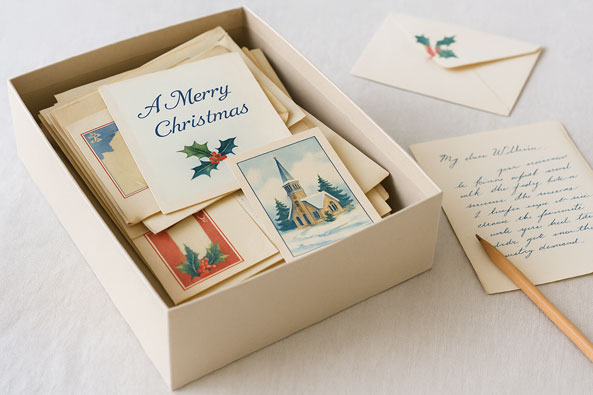
(Hint: You don’t have to keep them all.)
You know that moment in early January—the decorations are half-down, there’s glitter on the dining room table, and you’re staring at a cheerful little stack of Christmas cards? They’re lovely. They’re heartfelt. And if we’re honest…they’re starting to multiply.
So, what do you do with all those cards and letters once the holidays are over? Before deciding what to keep, it helps to pause and understand what these kinds of items represent within a family archive and why they matter before any decisions are made.
As an archivist (and a friend who has definitely faced her own mountain of festive mail), I’m here to tell you this: you don’t have to save them all.
Take a breath. We’re going to make it simple, guilt-free, and maybe even a little fun.
Start by Remembering What These Cards Really Are
Christmas cards and family letters are mini time capsules. They capture handwriting, humor, new addresses, family milestones, and yes—a few questionable sweater choices.
But not every card carries the same weight. Some are just store-bought signatures, others include notes that tug your heart. The key is learning how to save the meaning without saving the clutter.
“An archivist doesn’t keep everything — they keep what tells the story.”
That’s your guiding star. You’re not throwing away love; you’re choosing what represents your family’s story best.
Holiday cards are a good example of this. Taking a moment to understand how everyday items like Christmas cards fit within a family archive makes it easier to choose what represents the story without feeling pressure to keep everything.
Step One: Sort with a Smile
Spread your cards and letters out on the table (a cup of cocoa nearby never hurts).
Make three loose piles:
✔ Keep – The ones that make you pause and smile. Maybe it’s your grandmother’s handwriting or a note from a friend you’ve known for decades.
✔ Scan or Photograph – Cards with short messages or signatures you like but don’t need to store physically. Snap a photo and save it in a “Holiday Greetings” folder on your phone or computer.
✔ Let Go – Duplicates, generic signatures, and the ones that don’t spark a memory. Recycle them and thank them silently for the joy they brought in the moment.
The process should feel light and satisfying, not heavy. You’re curating, not cleaning.
Step Two: Keep One per Sender per Decade
If you receive a card every year from the same relative or family friend, keep just one that best represents their personality—maybe the first one they sent after a big move or the year they drew their own design.
You’re creating a snapshot of connection over time. That’s what gives your archive its charm.
Step Three: Add Context Before You Forget
Before you tuck the card or letter away, jot a quick note:
- Year received
- Who sent it
- Why you kept it (even a few words help future you remember)
You can write this directly on the back in pencil or slip a note inside the envelope. It turns an ordinary card into a small piece of family history.
Step Four: Give Them a Safe Home
Once you’ve chosen your keepers:
- Store them in an acid-free folder or small box (archival, if possible).
- Label the folder “Holiday Greetings” or “Family Letters.”
- Avoid plastic sleeves for glittery cards—they can trap moisture.
You don’t need fancy supplies yet. This is your First Pass—a simple, calm start to keeping things safe until you’re ready for deeper organization.
Step Five: Let It Be Enough
Here’s the secret every archivist learns: restraint is part of preservation.
Keeping fewer, more meaningful items helps the real stories stand out.
You’ll still have the warmth and handwriting and laughter—just without the overflow.
And next December? When those cards start arriving again, you’ll already know what to do with them.
Why It Matters
Because family archives are built from gratitude—not guilt.
Saving a handful of Christmas cards or letters is enough to represent a lifetime of connection.
You’re honoring the relationships, not hoarding the paper.
So this year, before you pack the decorations away, spend ten calm minutes curating the joy. That’s what an archivist—and a happy home—would do.
For a deeper look at why these small pieces of mail matter, read What an Archivist Sees in a Christmas Card.